
Paulding Parole and Probation Compared
Georgia places felony parole and felony probation supervision under the Department of Community Supervision, known as DCS. The legal source still differs. The Georgia State Board of Pardons and Paroles decides whether an eligible state prisoner receives parole before the sentence expires. A judge orders probation, including a probated sentence or the community portion of a split sentence. The Paulding court file may therefore be the best probation record, while the Board's database is the direct public search for a parolee.
| Question | Parole | Probation |
|---|---|---|
| Who orders it? | Georgia State Board of Pardons and Paroles | Sentencing court |
| What comes first? | A state prison term | A court sentence, sometimes with no prison term |
| Who supervises? | Georgia DCS | Georgia DCS for felony supervision |
| Best public proof | Parolee Database and Board record | Court sentencing or probation order |
| How it ends | Discharge, sentence end, or Board action | Completion or court action |
Supervision does not mean county jail custody. A released person may report to DCS while no longer appearing as “in custody” in the Paulding Sheriff system. Likewise, a person who bonded out can be free from jail without being on parole or felony probation.
- Parole
- Conditional release from a state prison sentence by the Parole Board.
- Probation
- A court-ordered sentence served under rules in the community.
- Discharge
- The formal end of custody or supervision in the responsible system.
- Absconder
- A supervised person alleged to have stopped reporting or left supervision without permission.
Verify Paulding Post-Release Supervision
Begin with the custody path. The Georgia Parolee Database accepts first and last names and can match partial terms. It is useful for someone released from GDC onto parole. It is not the correct search for a county detainee who only posted bond, and it does not replace a Paulding probation order.
- Confirm whether the person was held only at Paulding County Jail or entered Georgia state custody.
- For a state release, search the Parolee Database by first and last name and compare available identity details.
- Check the GDC offender query with inactive records included to confirm the state custody history.
- For probation, search the Paulding criminal case and open the sentencing, probation, or revocation pleadings.
- Use the DCS Dallas listing to identify the office serving Paulding and call before sending records or visiting.
- Ask the originating agency for formal verification when a public result is unclear or incomplete.
Paulding's case-search instructions say a criminal name should be entered as last name, comma, first name when no case number is known. A known criminal case number uses six digits and dashes. Opening the green plus sign reveals available pleadings, which may show probation length, sentence credit, revocation, or later discharge-related action.
Paulding DCS Dallas Supervision Office
The official DCS Dallas field office serves Paulding County and the Paulding Circuit. Its listing calls it a virtual office and provides a post office box instead of a public walk-in street address. Call first rather than assuming there is a lobby for an unplanned visit.
Georgia DCS Dallas Field OfficeP.O. Box 1662
Dallas, GA 30132
Phone: (678) 224-4397
Fax: (706) 558-3910
Hours: Monday-Friday, 8:00 a.m.-4:30 p.m. Eastern
DCS may help identify reporting-office information through proper channels, but it does not replace a court probation order, Parole Board status, or jail release record. The statewide DCS main phone listed in the research is (678) 783-4337.
The official DCS office image below comes from the same Dallas location listing.
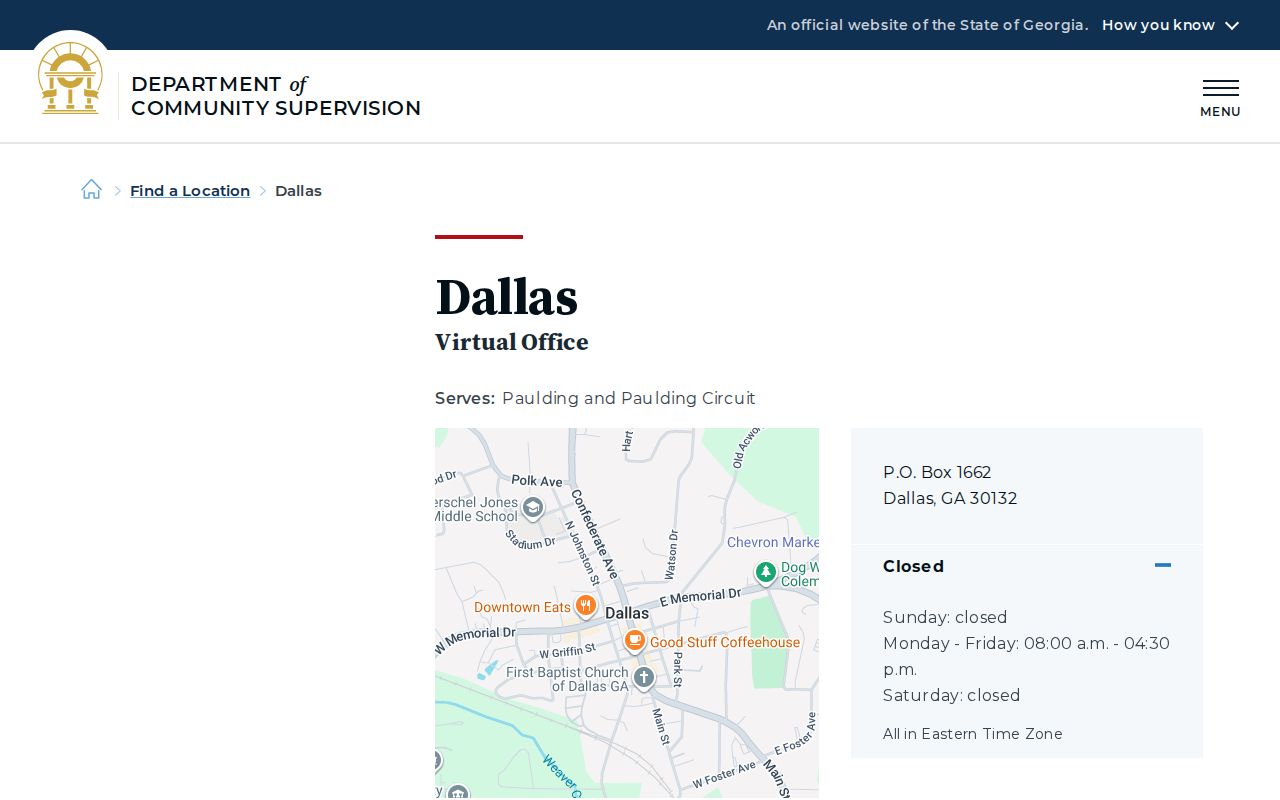
The virtual-office label is why phone and mail contact should come before travel.
Paulding Supervision Violations and Warrants
Conditions are rules attached to parole or probation. They can involve reporting, lawful conduct, approved residence, treatment, fees, travel limits, or other terms stated in the Board certificate or court order. The exact order controls. A violation allegation is not the same as a final revocation, which can require agency and court or Board action.
No official Paulding-specific public absconder database was found. Do not infer absconder or warrant status from a missing parole result, an old jail record, or an unanswered call. An absconder is generally someone alleged to have stopped reporting or left supervision without permission. Warrant confirmation belongs with the responsible law-enforcement or supervision agency. VINELink reports custody changes, not the full legal status of a supervision violation.
How Paulding Supervision Ends
Parole and probation end through the authority that created or controls them. A court record can show probation completion, modification, termination, or revocation. A parole record may reflect discharge or the end of the sentence under Board and DCS processes. Merely leaving the county jail does not end either form of supervision.
Use the Paulding County release-record paths when the question is whether custody ended, then use the parole or court record for the separate supervision question. Georgia's Open Records Act provides a general route to public agency records, subject to lawful limits. A precise request should identify the person, case or offender number, and the exact status or discharge record sought.
Note: An inactive GDC record can show that state incarceration ended without proving that every term of community supervision has ended.
Paulding Parole Decision Timing
The Tentative Parole Month lookup serves a different stage from the parolee database. A TPM is a future month for final Board review, not a release date. The Board can postpone or cancel it because of misconduct or unmet program conditions. At final review, the Board may set a parole release date, change its prior action, or deny release.
Georgia does not present ordinary parole review as a Paulding County court-style public hearing calendar for each inmate. Eligible people in GDC custody receive automatic initial consideration, so no parole application is required. A majority Board vote is needed for clemency. For non-life cases the Board may deny parole or establish a TPM; life cases use grant-or-deny decisions, with later reconsideration under Board policy after a denial.
O.C.G.A. § 42-9-45 generally provides initial consideration after nine months or one-third of a felony sentence, whichever is greater, unless another law controls. That is eligibility for review, not a promise of release. Serious violent felony rules under O.C.G.A. § 17-10-6.1 can bar parole for qualifying non-life sentences tied to covered crimes and dates.
Paulding Probation Center Releases
Paulding County has a state-run probation detention center in addition to the county jail. The Paulding Probation Detention Center is a GDC facility for adult male felons. It serves as a sanctioning option for people who need more security or supervision than ordinary community supervision and can be used after probation revocation or by direct court sentence.
A release from that facility should be traced through GDC, the court order, and DCS Dallas. The county jail roster is not the correct continuing record. Someone leaving the detention center may return to felony supervision instead of becoming fully discharged. Search GDC active and inactive offender records, then review the Paulding court case for the sanction or sentence terms.
Paulding Supervision Record Corrections
Record restriction is separate from supervision discharge. Paulding's record-restriction instructions say the Sheriff's Office handles only Paulding Sheriff's Office cases. Arrests made by Hiram Police, Dallas Police, Braswell Police, or Georgia State Patrol must be addressed with that arresting agency. The court and prosecuting authority also have roles under Georgia's restriction law.
This local agency split matters when a past arrest or release record appears wrong. The jail may hold the booking, the arresting police agency may hold the incident record, DCS may hold supervision records, and the clerk maintains the court disposition. Send a correction or restriction request to the office that created the disputed record rather than expecting one agency to revise every system.
Georgia calls the process record restriction. It does not automatically erase each court, jail, supervision, or public reference. For an arrest before July 1, 2013, Paulding directs the applicant to the arresting agency. For a later arrest, the prosecutor may approve restriction at sentencing or after a qualifying outcome. O.C.G.A. § 35-3-37 supplies the statewide framework, while the local page explains where a Paulding request begins.
Paulding Supervision Record Hierarchy
Conflicting records should be compared by purpose. The sheriff booking detail answers whether the county booking ended. GDC answers whether state incarceration is active or inactive. The Parole Board database addresses parole, and a Paulding court order controls probation terms. DCS carries out community supervision but does not turn the jail roster into a probation lookup.
A Tentative Parole Month belongs near the bottom of a release-confirmation hierarchy because it forecasts review rather than confirms release. A final Board action and parolee record are stronger after parole begins. For probation, the signed sentence and later court entries are more direct than an old booking page. If a public portal omits a fact, request the precise agency record instead of combining unrelated status clues.
| Question | Controlling Paulding or Georgia source |
|---|---|
| Did county jail custody end? | Sheriff release detail or Records Division |
| Did state custody end? | GDC inactive offender record and written verification |
| Is parole active? | State Board parolee record, confirmed with DCS when needed |
| What probation was ordered? | Paulding criminal court sentence and later pleadings |